Outfitting a Border Reiver
What a Border Reiver Took into Battle

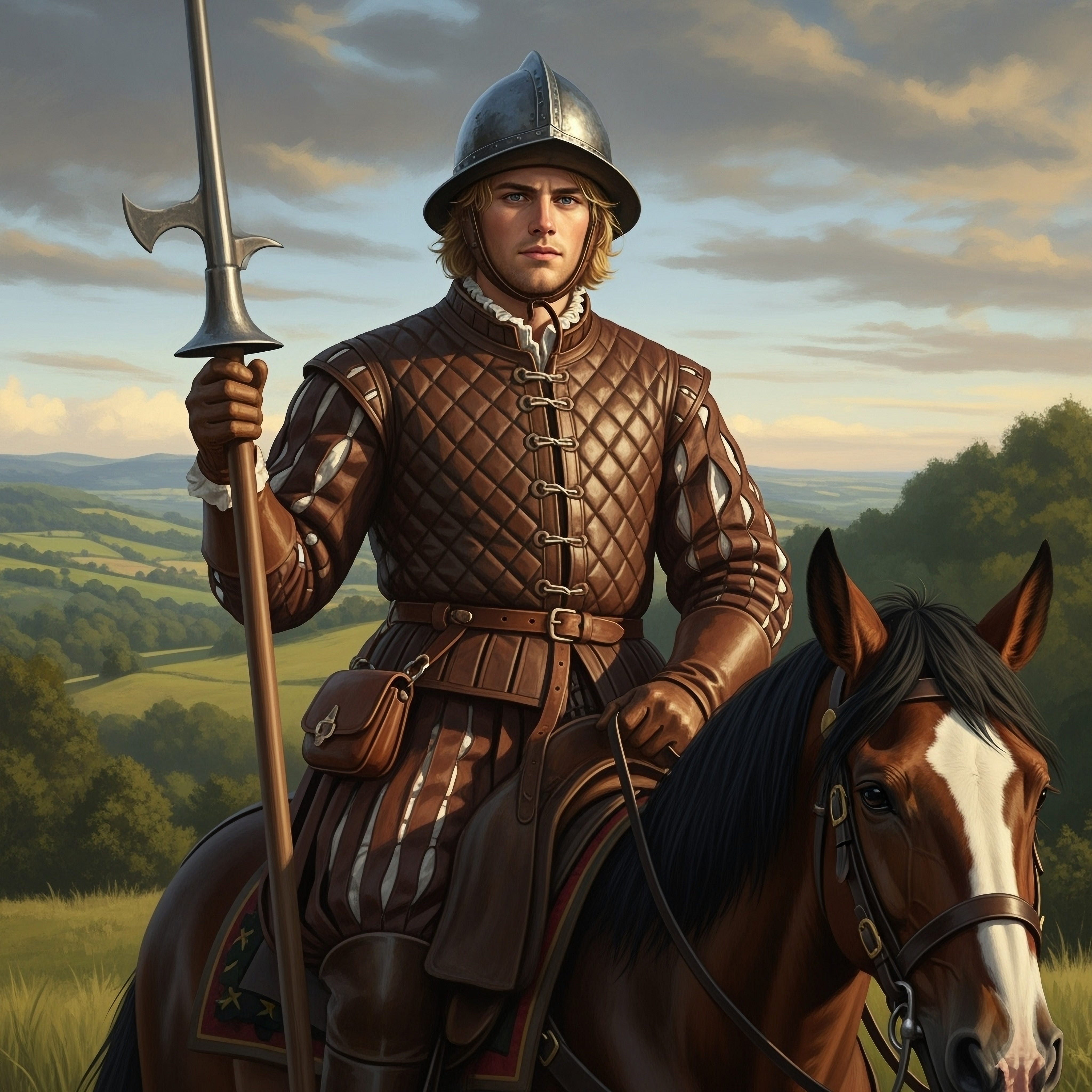
The typical Border Reiver had a very distinctive style of dress. They weren’t covered head to foot in armor like many of their counterparts. And yet, they were valued for their horsemanship and fighting skills. So, just how did the Border Reiver prepare for battle?
While some wealthier reivers might have opted for a breastplate or gorget, they were, at their core, light cavalry. Their aim was to travel fast, hit quickly, and be on their way, so most opted for the iconic jack of plaite. A quilted doublet of leather or canvas, the jack had pieces of steel or horn sewn between the layers of fabric. It protected the wearer without the weight of full armor and allowed for better mobility and range of movement. In addition, they could easily be sewn by a wife or mother, making them far more affordable for the average reiver.
For the most part, these jacks were sleeveless and worn over linen shirts, making them adaptable for all sorts of chores. They could be easily converted for battle by attaching padded or reinforced sleeves. These sleeves would often be made of the same material as the jack and attached to the main doublet at the shoulders by points. In a time before zippers and Velcro, points were laces that tied pieces of a garment together. Leather gauntlets might also be tied around the reiver’s wrists for added protection.
The Border Reivers did not wear kilts either. Instead, on their legs, they wore trews, breeches, or trunk hose of durable material, complemented by sturdy over-the-knee boots and spurs. Heavy gloves protected their hands, and thick scarves covered their neck. In addition, they always carried a plaid or blanket of sorts to wear around their shoulders if the weather called for it.
The most recognizable piece of their gear, however, was their steel bonnet, an open-faced helmet, typically a crowned morion or burgonet. Think Conquistadors. Beneath them, they would wear a heavy skull cap to line the helmet or a bonnet, a brimless wool cap, many times blue, especially on the Scottish side of the border.
Now that we’ve covered their clothing, let’s move on to one of their most cherished possessions, the hobbler or Border horse. Smaller than a modern horse, these hearty ponies were known for their stamina and surefootedness. Being smaller than a modern horse, they were quick, easy to maneuver, and less likely to take a tumble. Another positive attribute was the thickness of their hooves, which allowed them to remain unshod. Without the clatter of metal horseshoes, the reiver could approach a bastle house undetected, or at least long enough to surprise the inhabitants. The fact that they left no prints behind made it harder for their pursuers to track them as well. Alas, the hobbler, or Galloway pony, no longer exists today. The closest you might find is the fell or the dale pony.
Of course, no self-respecting Border Reiver would be found without a weapon or two, not if they wanted to live. The pike or border lance is the one most recognizable when thinking of the reivers. Unlike the well-known lance carried by the knights you’ve seen in movies, the border lance was much lighter, but in the hands of a skilled reiver, it could be just as deadly. A long, flexible pole, usually made of a light wood like ash, it was fitted with a sharp steel blade at one end. Equally effective from the saddle or on foot, it became a standard item in the reiver’s arsenal.
But even if the reiver was somehow disarmed and lost the use of his pike, he was not at the mercy of his enemy, for every reiver carried both a sword and at least one dagger. The swords were generally basket-hilted back swords. Aside from being lightweight, the blade was sharpened on one side, making it ideal for inflicting slicing wounds from the saddle as well as in hand-to-hand combat. As for the daggers, they were not yet called dirks in 1538, but one was a bollock dagger, named for the anatomical resemblance of its hilt to a male’s private parts – the bollocks. Many slipped them down in their boots for easy access, and they could be quite effective in close quarters. Some may have also carried a parrying dagger to use in concordance with their sword. This would likely be carried in his girdle or belt.
Along with the arms listed above, the Border Reiver also employed bows, sometimes from the saddle, but at other times on foot, such as when assaulting the approaching enemy from the upper stories of a peel tower. While the English generally favored the long bow, the Scottish reiver tended to prefer the latchet or latch crossbow. It was smaller and lighter than a regular crossbow and able to be wielded with one hand for easy use while mounted. In my Thunder on the Moor series, however, Will uses the latchet because he’s still able to fire it with one arm after being wounded in the shoulder.
In addition to these weapons, the typical Border Reiver was skilled with a number of polearms, each with a distinct purpose. The pike was mentioned at the start of this article. While utilized effectively by the reiver while mounted or on foot, it was the ultimate anti-cavalry weapon. Used for thrusting, it was popular for bringing down a horseman before he could reach you with his sword. The bill was another useful polearm. Not only did it feature a spike for thrusting at both ends, but one end had a hook as well, which came in handy if you wanted to drag a rider from his mount. It was mostly popular on the English side of the border. The glaive was yet another pole weapon, though less popular on the borders. It had a single-edged blade on the end, almost like a cleaver, which made it useful for chopping and slicing.
But the Border Reivers also had their own unique polearms, named for locations along the borders, especially north of the border. While the English favored the pike and the bill, the Scottish Borderers’ weapon of choice was the Jeddart Staff. Featuring a long sword-like blade, it was especially useful for slashing blows. Another, more popular in the Highlands, but sometimes seen on the Borders, was the Lochaber axe. Its axe-like blade was well suited for a chopping blow, and the other end sported a hook, which could come in handy for yanking the enemy from the saddle, perhaps after a chopping injury to the leg.
All in all, the Border Reiver had an impressive armory, and they were skilled at using each weapon within it. During times of war, they were valued for their horsemanship and expertise with arms, but when the war was over, they were cast aside, no longer useful to their kings, and left to fend for themselves in a territory that had been ravaged by war. And that is just what they did. Is it any wonder that the Border Reiver did just that?